

The Plant Head's 8 AM Question

At 8 AM the plant head asks the simplest question in manufacturing: how did we do yesterday, and what stopped us?
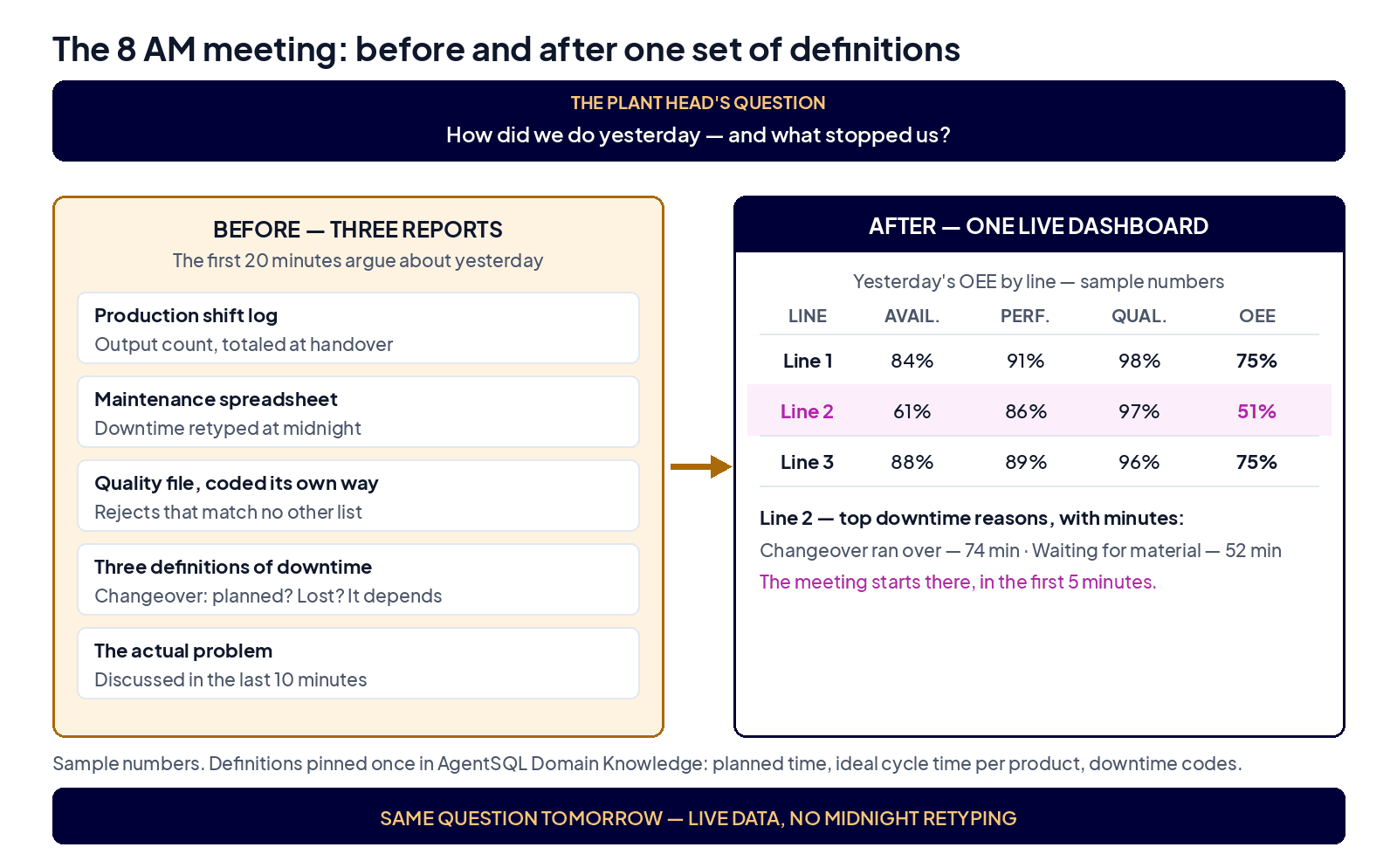
The room should answer in a minute. Instead it opens three versions of yesterday. Production has a count from the shift log. Maintenance has downtime in a notebook that became a spreadsheet at midnight. Quality has rejects in a separate file, coded its own way. Each number is honest. None of them line up, because each one was built to close a shift, not to run a meeting.
So the first twenty minutes go to reconciliation — which count, which stop counted as planned, whether a slow run was downtime or just a hard product — and the last ten go to the actual problem, with the line already running behind the meeting. The plant does not lack data. It lacks one place where yesterday was defined once.
Yesterday lives in shift reports
Look at what a shift actually produces. The line records output and stops as they happen, often on paper first. A supervisor totals it at handover. Someone retypes the totals into a spreadsheet for the morning pack. Quality logs inspections somewhere else, with reject reasons that do not match the downtime reasons. Maintenance keeps its own history of breakdowns and changeovers.
Every handoff in that chain is a chance for a definition to drift. One shift counts a changeover as planned downtime and excludes it. The next counts it as lost time. One team records minor stops; another only records stops long enough to notice. By 8 AM, "downtime yesterday" is not one number waiting to be read. It is three numbers waiting to be negotiated.
A live view starts somewhere else: connect the sources the plant already has — production counts, downtime events, quality results — once, in one workspace, and leave them connected. TridaPad is that workspace: it connects to 50+ SQL, NoSQL, Big Data and cloud sources, so a plant system, a quality database and a maintenance log can be queried side by side without replacing any of them. The shifts keep their systems. The morning meeting stops retyping them.
Connection alone does not settle the argument, though. The argument was never only about access.
OEE is three numbers, not one argument
Plants already have a language for yesterday. Overall equipment effectiveness — OEE — is availability multiplied by performance multiplied by quality. Availability is run time divided by planned production time: it charges breakdowns, setups and changeovers. Performance compares what the line made while running with what it would have made at its ideal cycle time: it charges minor stops and slow running. Quality is good count divided by total count: it charges scrap and rework.
The formula is not the hard part. The hard part is that every term hides a local decision. What counts as planned time? Which cycle time is "ideal" for a product the line runs twice a month? Does a reworked part count as good? Two lines can report the same OEE formula and mean different things by every word in it — and a plant head comparing lines, or the same line across shifts, is comparing definitions as much as performance.
That is the job of AgentSQL Domain Knowledge in a plant. AgentSQL is the agentic analytics layer inside TridaPad — it takes a plain-language question, discovers the schema, writes the SQL, tests it and verifies the result before showing it. Domain Knowledge means the plant's own vocabulary, metrics and rules are built into that agentic core on the plant's own data: planned time defined once per shift pattern, ideal cycle time pinned per product and line, downtime reason codes mapped once from the words each shift actually uses, scrap and rework kept distinct. The 8 AM question then runs against definitions the plant agreed once, instead of definitions each shift improvised.
One question at 8 AM, asked once
Take a mid-size plant running three lines across two shifts. The numbers below are sample numbers; the question is the one its plant head asks every morning.
"Show yesterday's OEE by line, split into availability, performance and quality, and list the top downtime reasons for the lowest line."
AgentSQL writes it against the connected view — each line's shift summary already carrying the pinned fields: planned minutes, run minutes, the ideal cycle time for the product run, total count and good count. One query, open for anyone to read:
-- Yesterday's OEE by line: one set of definitions for every line
-- availability x performance x quality, from the pinned plant fields
SELECT line_name,
       ROUND(100.0 * run_minutes
             / NULLIF(planned_minutes, 0), 1)          AS availability_pct,
       ROUND(100.0 * (ideal_cycle_seconds * total_count)
             / NULLIF(run_minutes * 60, 0), 1)         AS performance_pct,
       ROUND(100.0 * good_count
             / NULLIF(total_count, 0), 1)              AS quality_pct,
       ROUND(100.0 * (run_minutes / NULLIF(planned_minutes, 0))
             * ((ideal_cycle_seconds * total_count)
                / NULLIF(run_minutes * 60, 0))
             * (good_count / NULLIF(total_count, 0)), 1) AS oee_pct
FROM line_shift_summary
WHERE shift_date = CURRENT_DATE - INTERVAL '1 day'
GROUP BY line_name, run_minutes, planned_minutes,
         ideal_cycle_seconds, total_count, good_count
ORDER BY oee_pct;
In the sample result, Line 2 comes out lowest — and the split shows why before anyone argues about it. Its quality is in line with the other two. Its performance is a few points down. Its availability is where the day went: a long changeover that ran over, then a stretch coded as waiting for material. A second, short query against the downtime events for that line names those two reasons with minutes attached, so the meeting starts there — changeover crew, material staging — instead of starting with whose spreadsheet to trust. The query is saved, its charts become the morning dashboard, and tomorrow the same question re-runs on live data. AgentSQL can also autodiscover insights across the connected lines — a line whose minor stops creep up week over week shows up as a pattern, not as a surprise at month end.
What changes when the meeting starts with the answer
The reconciliation work shrinks to its honest remainder. Shifts still record what happened — that record is the raw material, and it still matters. What disappears is the second job built on top of it: the midnight retyping, the pack assembled by hand, the twenty minutes spent agreeing on yesterday before anyone can discuss today.
Follow-ups change shape, too. "Was that changeover long, or do our changeovers just run long on that product?" is a question typed in plain language against the same connected data, answered in the meeting, not a request sent back to a supervisor for tomorrow. Over weeks, the saved queries become the plant's memory: downtime reasons stop drifting, because the mapping is written down in the layer that generates the numbers, and a new shift lead inherits the definitions instead of reinventing them.
What this does not fix
Honest limits. First, the definitions still have to be agreed by people: production, maintenance and quality have to sit down and decide what planned time means, which cycle times are ideal, and how rework counts — that meeting is the work, and software only makes its outcome stick. Second, reason codes are only as good as the recording at the line: a stop nobody coded cannot be ranked, and the dashboard will show the gap as uncoded time rather than hide it. Third, this does not fix the changeover or stage the material — it gets the room to the right problem in the first five minutes instead of the last ten. The fixing is still the plant's work, done on the floor.
Start the meeting with the problem, not the numbers
If your 8 AM meeting argues about yesterday before it can fix today, the problem is not effort — every shift did its paperwork. It is that yesterday was defined three times, in three places, by hand. Connect the sources once, pin the definitions once, and let the plant head ask one question against live data. Try AgentSQL on your own lines — or write to us at data@tridalabs.com and tell us which number your morning meeting argues about most.