

Data Engineering Is Not Hard. Your Tools Are in Five Places.
A sales head in Pune asks a plain question on a Monday morning: which city gave us the most orders last month?
The question is not hard. The route it travels is.
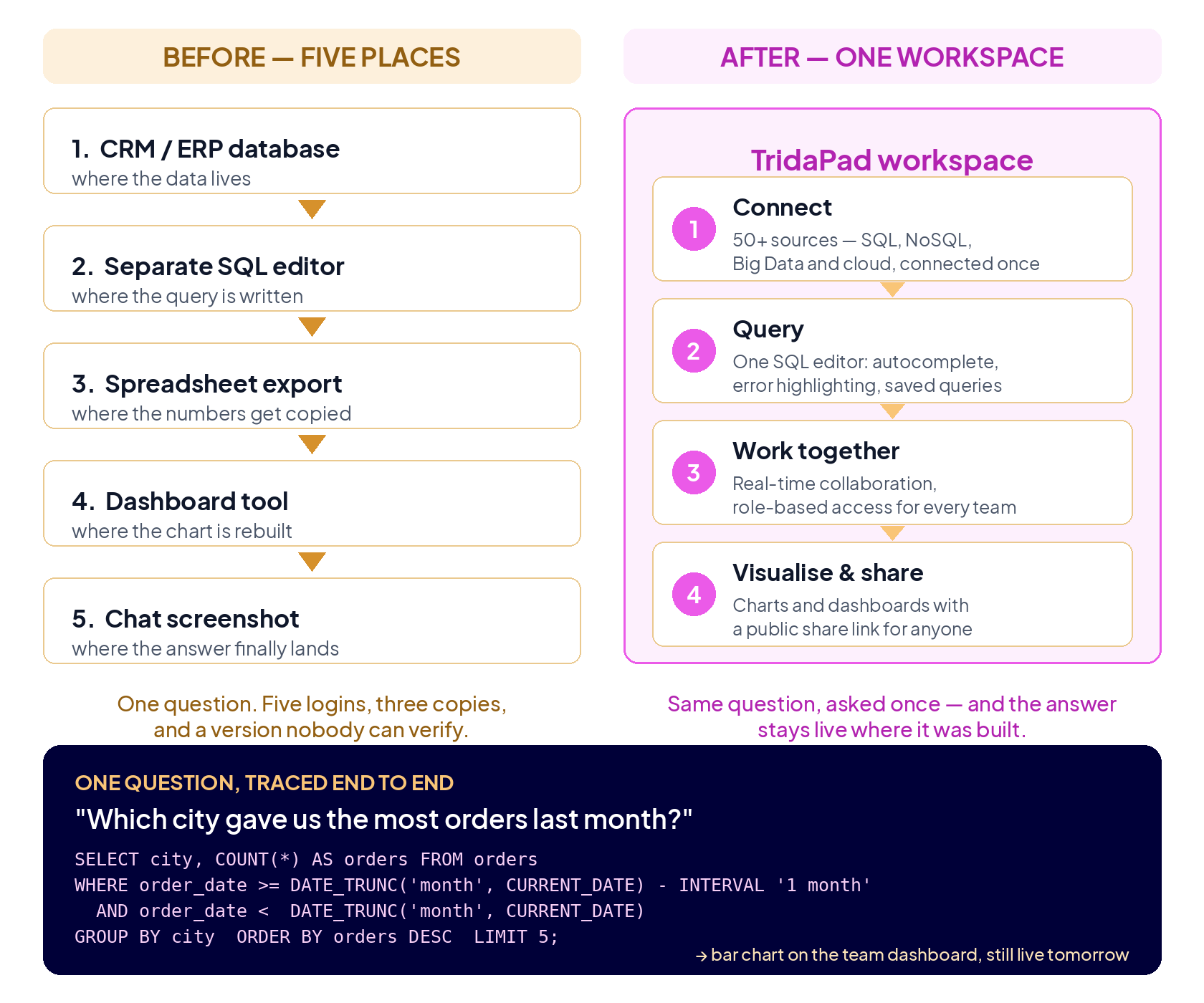
The orders sit in the CRM database. The analyst who can query that database opens a separate SQL editor, because that is where she works. She runs the query, exports the result to a spreadsheet, and cleans it there, because two city names are spelled three ways. She rebuilds the chart in a dashboard tool, because the chart from last month used last month's export. Then she takes a screenshot and drops it into the team chat, because that is where the sales head will actually see it.
Five places. One question. By Friday, nobody can say which of the three copies of that spreadsheet was the right one.
The five-place relay
Most mid-size Indian companies we talk to do not have a data problem. Their orders, payments, inventory and support data all exist, and most of it is reasonably clean. What they have is a relay problem.
Every handoff in the relay costs something specific:
The export goes stale immediately. The moment a result leaves the database and lands in a spreadsheet, it is a photograph of the past. The business keeps moving; the photograph does not.
The query lives in one person's editor. When the analyst is on leave, the query is on leave. There is no shared, searchable copy the team can rerun.
The chart is rebuilt, not refreshed. A dashboard built on an export has to be remade every cycle. The work repeats; the insight does not compound.
The answer loses its proof. A screenshot in a chat thread carries no query, no date range and no source. When two screenshots disagree, there is nothing to check.
None of this needs a bigger data team. It needs the five places to become one.
What one workspace actually changes
TridaPad is an AI-native data collaboration platform. It connects to 50+ data sources — SQL, NoSQL, Big Data and cloud — and the connection is made once, by the team, not once per question per analyst.
Inside that one workspace, the relay disappears:
Connect once. The CRM, the payments database and the warehouse sit side by side as sources the whole team can see, with role-based access deciding who sees what.
Query where the data lives. A modern SQL editor with autocomplete and error highlighting runs against the live source. No export step exists, so no export can go stale.
Keep the query. Queries are saved, organised and searchable as team assets. The Monday question becomes a named query anyone with access can rerun on Tuesday's data.
Chart and share in the same place. Results become charts — bar, line, funnel, map, pivot and more — and charts become dashboards with a public share link. The sales head opens a live dashboard, not a screenshot.
Deploy it where your data is allowed to live. TridaPad runs in the cloud or self-hosted — on Render, AWS, Azure, GCP or on-premises — so the workspace moves to the data's rules, not the other way round. Setup takes minutes, not a quarter.
The same question, in one place
Here is the Monday question asked the one-workspace way. The analyst opens TridaPad, selects the orders source, and runs:
SELECT city, COUNT(*) AS orders
FROM orders
WHERE order_date >= DATE_TRUNC('month', CURRENT_DATE) - INTERVAL '1 month'
  AND order_date <  DATE_TRUNC('month', CURRENT_DATE)
GROUP BY city
ORDER BY orders DESC
LIMIT 5;
That is the whole job. The result is attached to a bar chart, the chart is added to the sales dashboard, and the dashboard link goes into the chat instead of a screenshot. Next Monday, the same dashboard already shows the new month, because it was never an export. When the sales head asks why one city's number moved, the query is right there under the chart — same source, same date logic, open to anyone with access.
And when the question changes — "orders are fine, now show me returns by city" — nobody starts a new relay. It is one more saved query in the same workspace, built on the same connection.
What one workspace does not fix
Honesty matters here, because a workspace is not magic.
It will not repair bad source data. If the CRM holds three spellings of one city, the chart will faithfully show three cities until someone cleans the source or handles the mapping in the query. It will not settle arguments about definitions — whether an "order" means placed, paid or shipped is a business decision, and the team still has to make it once and write it into the saved query. And access still has to be set up properly: role-based access only protects data when someone assigns the roles with care.
What it does fix is the relay. The copies, the rebuilds, the screenshots, the unanswerable "which version is this?" — those are tooling problems, and tooling problems have tooling answers.
Start with the question your team asks every week
Do not begin by migrating everything. Connect the one source behind the question your team asks most often, save that query in TridaPad, put its chart on a dashboard, and share the link the next time the question comes up. If the relay was the problem — and it usually is — you will feel the difference in the first week.
Try TridaPad — one workspace for your sources, queries, charts and dashboards. Questions about a pilot on your own data: data@tridalabs.com.